By Diane Rosen
While creativity is observed across a variety of fields and human endeavors, what creative individuals may share in common is a heightened ability to engage in contradictory modes of thought, including cognitive and affective.
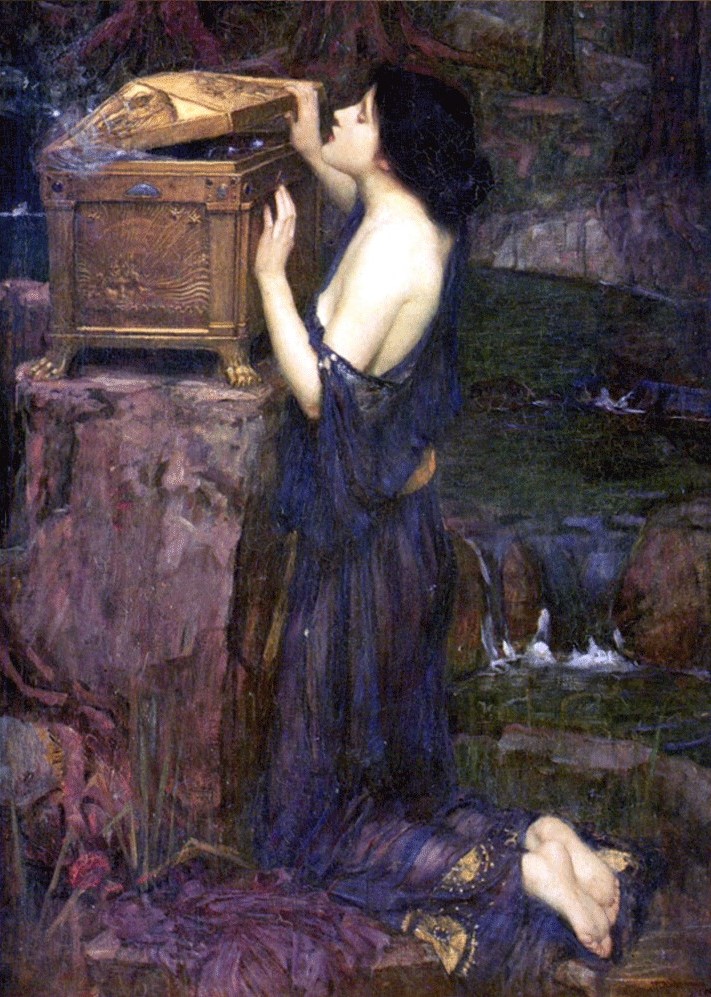
Creative expression in [any] modality can open a Pandora's box of material from our unconscious. It takes great courage to confront this.
Creativity is discussed first in terms of Carl Jung's pioneering psychoanalytic theory of opposites, as mirrored in the night sea journey archetype: a descent into the unknown where bounded consciousness and the limitless unconscious collide. Galvanized by its very contradiction, this "journey" is the crucible of personal development and all creative change. Continuing the theme of constructive errancy, creativity is then considered in terms of mind wandering, a shift of attention inward that heightens unconscious divergent processing. Creativity is a form of deterministic chaos that thrives on the conflict between conscious-unconscious, logical-irrational, cognitive-affective processes over time.
Creativity surrounds us, yet defies explanation. If not ex nihilo, how do creative ideas and artifacts come to exist? The concept of creativity has undergone many changes over time, from divine inspiration to Darwinian blind variation-selective retention of ideas; something novel and useful (adaptive); Wallas' well-known four-stage model, Preparation (domain knowledge, experience), Incubation (time away from a problem), Illumination ("eureka" moments), and Verification (testing, elaboration); bisociation of unrelated matrices; psychological-emotional flow; divergent-convergent thinking; neurodynamic information processing. Attempts to analyze creativity, however, generally describe more than they explain. Whether it is defined as everyday/ personal, i.e. a widely distributed capacity, or more narrowly as eminent/ historical, the inventive imagination operates in secret. How does it work, exactly? How is the aesthetic sensibility aroused, driven to combine unlikely elements into a novel construct? We have only hints and analogs
From my perspective as a visual artist, French mathematician Jacques Hadamard comes closer than most creativity theorists. In a genuine departure from the empirical mainstream, his 1944 essay The Psychology of Invention in the Mathematical Field ascribes a key role to unconscious mental processes in the selection of ideas. Moreover, he credits affect and the sense of beauty in particular as being the stimulus for every type of creativity. During incubation, Hadamard says, "ideas chosen by my unconscious are those which agree with my aesthetic sense". In this view beauty is a fundamental motivating power, an intrinsic urge to seek answers that are novel and true (useful) but also satisfying; aesthetic qualities therefore act as a kind of chaotic attractor toward which an evolving creative system tends. In a related point, one contemporary cultural theorist states that creativity in all its forms "is the art of affect more than representation, a system of dynamized and impacting forces" that influence both maker and observer
This article explores creative incubation as a nonlinear dynamical process in which affect plays an integral part, bending and blending thoughtboundaries. Creativity is discussed first in terms of Carl Jung's pioneering psychoanalytic theory of opposites, as mirrored in the night sea journey archetype: a descent into the unknown where bounded consciousness and the limitless unconscious collide. Galvanized by its very contradiction, this "journey" is the crucible of personal development and all creative change. Continuing the theme of constructive errancy, creativity is then considered in terms of mind wandering, a shift of attention inward that heightens unconscious divergent processing. Finally, Nonlinear Dynamical Systems theory brings into sharper focus what these psychotherapeutic and neurodynamic systems only suggest: creativity is a form of deterministic chaos that thrives on the conflict between conscious-unconscious, logical-irrational, cognitive-affective processes over time. NDS theory not only grounds this elusive subject, but also illuminates the turbulent quality of conditions that are favorable to creativity across disciplines.
THE NIGHT SEA JOURNEY
Descending into the unconscious, the conscious mind puts itself in a perilous position. It is in the situation of the primitive hero who is devoured by the dragon: a diminution or extinction of consciousness, an abaissement du niveau mental. The value of the imagination lies in its polyvalence, since every image allows endless transpositions... The poeisis of the dream [and creative work] is characterized by the paradoxical identity of opposites, the coincidentia oppositorum, which Jung exploits when exploring the self in relation to the collective unconscious.

What alchemists called the "chaos" or prima materia is the primeval source of all undifferentiated potentiality, often represented by darkness or the sea. Jung identifies this fertile primordial state with the unconscious. Psychological and creative transformation was seen to occur through a process emulating the latent vitality of synthesized opposites, embodied in ancient depictions of prima materia as a paradoxical androgynous being: Hermaphroditus, the original unity and matrix of all potentialities, the world-creating spirit; the Greek god Eros, "a divine Urkind whose powers are not yet differentiated"; Yin-Yang, the dark feminine and light masculine principles, each inherent in the other, driving the other's potentiality into actuality; Adam before the creation of Eve, fashioned of clay that was part of the original undifferentiated chaos. Even pre-eminently male or female divinities were considered to have a dual nature, because androgyny came to signify the prototypical union of opposites in seamless, self-contained wholeness, an archetype of universal distribution to which all possibilities belong.
With the Enlightenment, notions of lateral multiplicity were eclipsed by a hierarchal worldview; the privileging of reason permeated every discipline, including the arts. Nineteenth century aesthetics, for example, valued the austerity of draftsmanship as a timeless expression of masculine (Apollonian) intellect, while color was disparaged as frivolously feminine, hedonistic (Dionysian) and a threat to masculine culture. Harking back to Eve, "woman" was seen as the personification of nature's irrational and destructive forces. Rejection of this perceived chthonic power was rationalized as the logical response to disruptive unconscious material and unbridled emotion. "The Apollonian line," asserts social critic Paglia, "separates objects from each other and from nature. Disgust is Apollonian fear at a melting borderline". At just such borderlines, however, is where all change occurs
The archetypal night sea journey represents this generative process of transformation at porous divides. Known from primitive times and in myths of all cultures, it almost universally follows a dialectical pattern Campbell calls the "nuclear unit of the monomyth": complete separation from the world as a form of self-annihilation, potentially harmful or illuminating; penetration to and confrontation with a primal source of power; and a life-renewing return. Jung envisioned several fundamental psychoanalytic themes in terms of this archetype, including the healing-destructive aspects of introversion, and death/rebirth as a psychological trajectory through unconscious realms impenetrable to reason. The night sea journey offers a useful frame for probing creativity as well, beginning with the perilous descent below conscious awareness.
DEPARTURE
Through a spontaneous activation of unconscious contents, new interests and tendencies appear which have hitherto received no attention... During the incubation period of such a change we often observe a loss of conscious energy, seen most clearly before the onset of certain psychoses and in the empty stillness which precedes creative work.
From spiritual quests to dreamscapes and the imagination, the primordial night journey figuratively maps a great variety of personal travails and transformations. It begins in total withdrawal of interest from the known world and disappearance into darkness, outside of time. Iconic examples of such retreat include Odysseus in the underworld; Jesus entombed; Jonah swallowed by a whale; and the mythic sun-hero's undersea passage inside the belly of a dragon. Creative behavior is certainly based on a similar dissociation that simultaneously deactivates consciousness (the "light" of reason), and animates the prolific unconscious ("darkness"). Jung's term for the complex dynamic that unites the two is the transcendent function, a key organizing principle for which transcendent denotes not a metaphysical quality but a psychological function, comprised of other complex functions, and organically facilitating state transitions by a mutual confrontation of opposites.
These opposites manifest as the known self and its alterity, corresponding to the dynamic syzygy of conscious and unconscious content. Eyes shut against the external world, the dreaming/creative self plunges downward into the night sea, a nether region where familiar narratives of established identity are disrupted, and ego is annihilated. The antithetical shadow-self comes forth, forming an oppositional dyad "constituted dialectically by the confrontation with an alterity that is both indigenous and alien to itself... In the chaos, confusion and flux of dreaming, fixed boundaries of subjectivity are dissolved". For this transpersonal being there is no longer a unified "I," no center, no striving for order, connection or logical understanding. Instead, disjointed shards of data can freely self-organize into new narratives that will be endogenously defined.
A word about technique regarding the images included herein: the dynamic interplay of familiar-and-mysterious, known-and-unknown that so typifies human nature has always been my preferred subject matter; it also informs my process. I begin each mixed media piece by preparing the surface with poured, dripped and spattered paint, resulting in marks that enhance the composition in ways I could never have planned. Figures are then rendered using pastel in the style of traditional realism, but layered over and frequently incorporating the strangely mottled background patterns, they appear enmeshed in an indeterminate, irreal space.
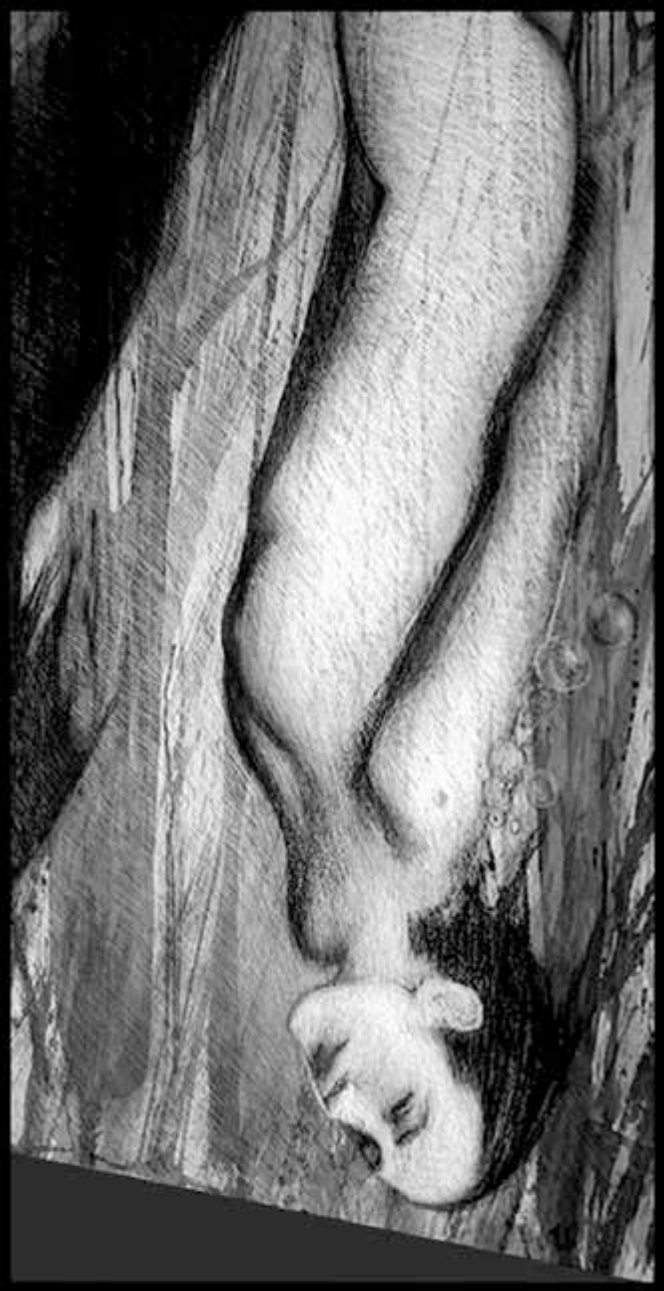
Returning to Fig. 1, a sense of instability is evoked by the upside-down positioning and trails of randomly streaked paint that signify the dive into chaotic waters. Here, estranged from everyday reality, in a prologue to critical confrontation, the dreamer, artist or celebrant of alchemical mysteries merges with darkness and suffers a figurative death-- the prerequisite for change.
The self is made manifest in the opposites and in the conflict between them; it is a coincidentia oppositorum. Hence the way to the self begins in conflict
The process that at first looks like an alarming regression is rather a reculer pour mieux sauter, an amassing and integration of powers that will develop into a new order
The second, liminal stage of the sea journey is equivalent to alchemical solve, the breaking down of an essential elixir in the retort by repeated distillations and reconstitutions. Inside the belly of the sea-monster (i.e. the enormity of divergent energies), complex systems of the psyche disintegrate and the hero undergoes a period of struggle. As the embodiment of life energy flowing back to its fundamental, unconscious source, he is engulfed by its infinite, often disquieting, contents; restoration of equilibrium (the convergent whole) is not assured. Jung likens this tension of opposites to a state of physical recoil: a backward movement and compression of the body, the better to leap forward (reculer pour mieux sauter). Aligned with this preparedness-to-spring is the inherent psychological readiness-for-action, a pivotal condition for return to progression. This edge-of-chaos energy is the stimulus for a dialectics of change.
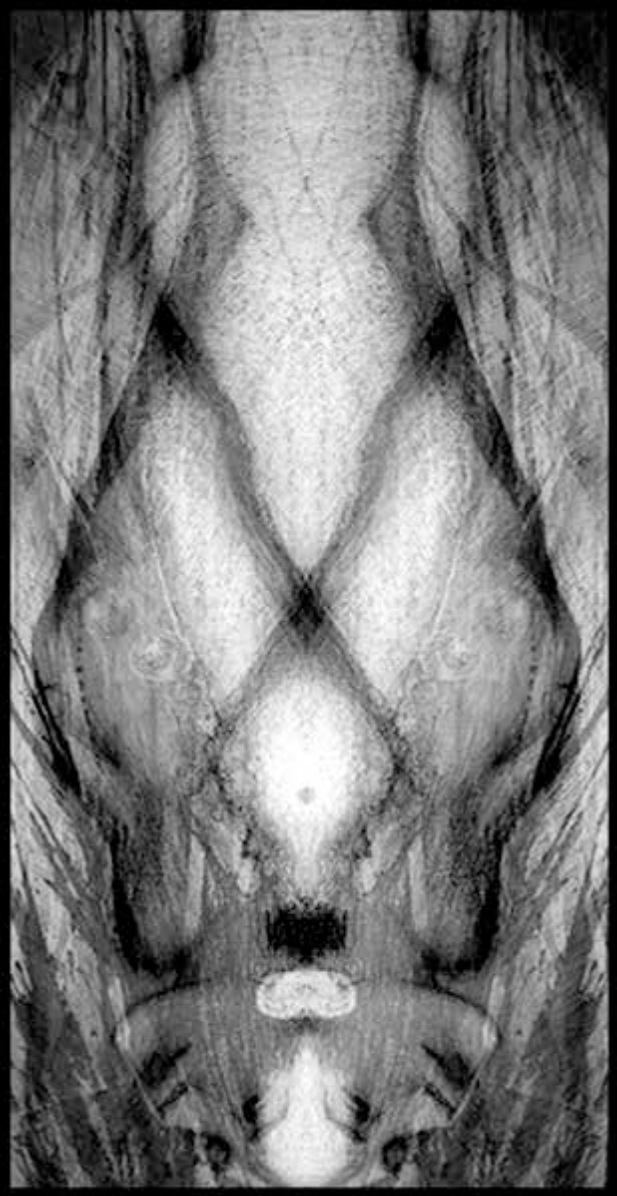
Figure 2 depicts the coincidentia oppositorum, known and unknown, self and anti-self, in primal conflict. The binary image is based on Figure 1, which itself exploits a chaotic aesthetic in the propulsive layout and an ambient pattern of paint "decided" by chance. Here, two partially transparent versions of the original are rotated and superimposed, placing the intertwined pair in a chaotic, oscillatory dimension at the intermediate, regressive phase of transcendent function. Though fraught with danger, this transitional phase space is the wellspring of creativity, wholeness and health. Indeed, the therapeutic utility of dissolution is widely acknowledged, especially among psychoanalytic practitioners and theorists influenced by the nonlinear paradigm. If integrated by the psyche, unconscious content itself constitutes a widening of consciousness that potentially transforms darkness into a source of illumination.
At this threshold of chaos, between the "macro" of controlled conscious awareness and the "micro" of deeply embedded unconscious layers, ideas take root. Across disciplinary fields and scales, from biological-cellular to neurocognitive, psychosocial and cultural, such complexity in interactive networks is known to yield optimal variation, flexibility and adaptive strength. Hence the core creative paradox: disintegration enabling synthesis, destabilization empowering stability, disorder engendering new order
Return/Emergence
In all chaos there is a cosmos, in all disorder a secret order, in all caprice a fixed law, for everything that works must be grounded on its opposite... The judging intellect with its categories proves itself powerless
If a union is to take place between opposites like spirit and matter, conscious and unconscious, bright and dark, it will happen in a third thing, which represents not a compromise but something new... an entity that can be described only in paradoxes.
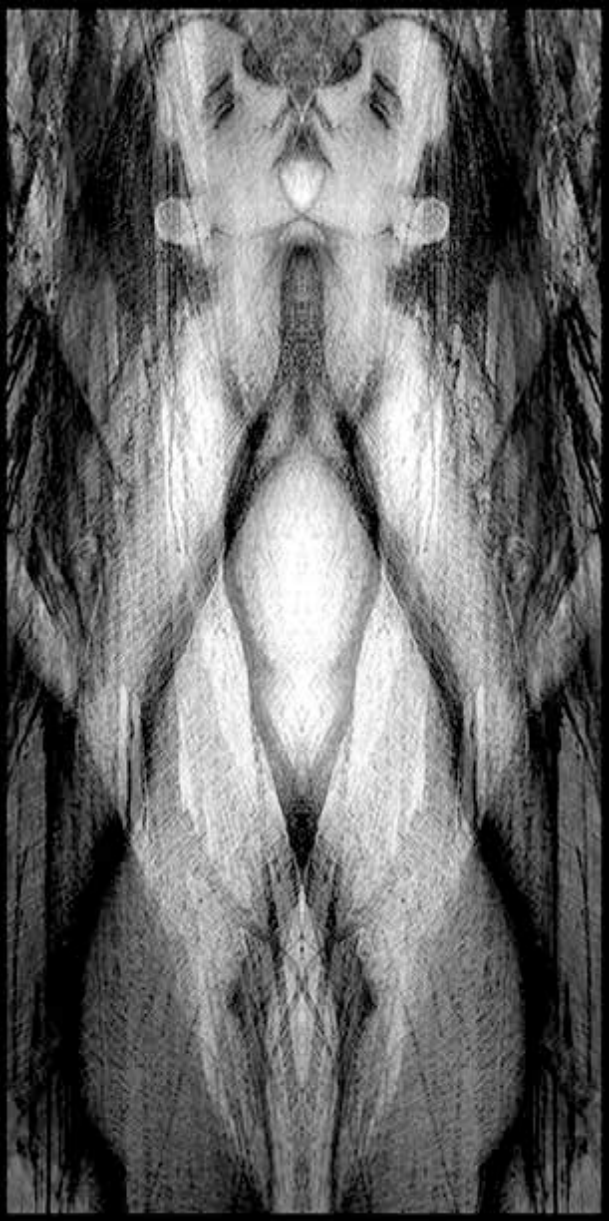
From the alchemical solve or dissolution, stimulated by a destabilizing and compensatory energy that seeks renewed balance, the distillates arrive at coagula and reintegrate as something new. Figure 3 depicts such progression to a novel, more complex state. In this image, antithetical selves personify the generative power of opposites; an ovoid shape, a new "third thing," emerges from their dialectical encounter. This, too, is an iteration of Fig. 1, only now the self and its alterity are rotated toward each other and rendered as unified rather than bifurcated antinomies. The new entity retains traces of its nonlinear formation, a combination at once retrospective and prospective. Method (process) and meaning (interpretation) link these three illustrative Figures to each other and to the dynamics of chaos, with small changes to successive executions triggering unpredictable results.
Like the archetypes mediating between consciousness and the continuously active unconscious substratum, and bifurcations that become points of growth in chaotic systems, creativity serves to integrate the past and point forward to future possibilities. T. S. Eliot perfectly captures the enigma of this ubiquitous life process in his Four Quartets: "What we call the beginning is often the end/ And to make an end is to make a beginning./ The end is where we start from". As implied by the hero being swallowed into the bowels of a monster, one must enter a region of danger to pursue any "treasure hard to attain," whether the spiritual apotheosis of Unus Mundus symbolized by alchemical gold; integration of the psyche as an individuated self; or transformative creative inspiration. The devouring monster can only be overcome from within, where forces of instability destroy but also recirculate and reorganize affective, aesthetic and psychological energies. So, although disappearance into the dragon initiates the regressive phase, its course tracks west to east with the hero emerging at the moment of sunrise, symbolizing recommencement of progression and the promise of development.
The arc of this mythic sea journey is intriguingly paralleled in Orsucci's exploration of dynamical brain-mind space, delimited etymologically by the two interdependent conceptual poles of e-mergence (hyphenation original) and mergence: merge, from L. mergere, "to plunge, dive, dip or sink in;" and emerge, "bring forth, bring to light, arise from or out of," from emergere: ex- "out" + mergere." These reciprocal concepts, he notes, form a "dynamic couple" whose emergent properties are "effects that are somehow multipliers of [the components]" in the process. Transcending simple cause and effect summation, combinatorial turns in creativity's conceptual terrain may be comparably outlined: e-mergence entails mergence; a beginning is inseparable from the regressive vortex, the "end."
Redolent of the sea in its history and cognates, mergence conjures unfathomable briny depths of the archetypal journey. Neuroscience indicates that creativity occurs in just such a fluid underrealm.
MIND WANDERING: UNCONSCIOUS ODYSSEYS
IUnconscious processes reflect neural encoding and storage of information and memories of which we can never ever become consciously aware... What is unconscious at higher more effortful levels, may reemerge spontaneously when one abdicates higher control, as in dreams and meditation, [or] when its intensity mandates deliberative action, as in very intense affective experiences.
When not thinking directedly, our thoughts float, sink or rise according to their specific gravity... Thinking in verbal form ceases, image piles on image, feeling on feeling, and there is an ever-increasing tendency to arrange things not as they are in reality but as one would like them to be... We wander from the subject. Through fantasy-thinking directedthinking is brought into contact with the oldest layers of the human mind, long buried beneath the threshold of consciousness.
Forms of mind wandering have been linked with creative inspiration for thousands of years, in myth as well as anecdotes of actual discovery. But it has taken the relatively recent technology of neuroimaging to provide direct evidence that "conditions favoring mind wandering enhance creativity", and to demonstrate convincingly that unconscious processing is crucial to creative cognition
Defined as the experience of engaging in cognitive events independent of perceptual input and current task-demands, mind wandering is a drifting of attention inward, a disconnection from external stimuli that is also known as perceptual decoupling. Underlying mind wandering is the default mode, a network of neural systems active during periods of taskunrelated-thought and apparently inactive for task-positive functions of its complement, the cognitive control network. During creative incubation (the mythic regression), unconscious mentation seems to ignite networks and association cortices rather than a single, specific brain region. Within this system of multiple interacting subsystems, submerged memories along with thoughts of the future form the basis for flexible construction of self-relevant mental simulations. Production of something novel and useful, then, depends at least in part on "disinhibitory neuronal processes" of the unfettered default network, while evaluating and refining retained ideas appears to depend on the cognitive control network.
Jung anticipated these neurodynamic systems when he proposed two primary, interactive modes of thought: conscious-directed (cognitive control), and archaic fantasy thinking (default mode processing), an affect-driven unconscious modality that works by analogy and association in dreams, fantasies (daydreams), and periods of creative incubation. Although his terminology is sometimes dated-- "fantasy thinking" was the locution then in use for mind wandering and the phantasms of dreams-- Jung conceives the emergence of reorganized unconscious content into consciousness in terms of threshold intensity, language echoed much later by Vandekerckhove and Panksepp (above) and others. Within the unconscious, he wrote, "reside all the fantasy combinations that have not yet attained to the threshold intensity, but which in the course of time and under suitable conditions enter the light of consciousness". Thus the sea journey archetype vividly, and rather accurately, portrays mind wandering and its role in creative process as "dying" to the exteroceptive world, and turning inward to deeply cached strands of memory and imagination.
Complementing the cognitive paradigm, affective neuroscience further enables us to envision the enterprise of incubation through the operation of primary-process emotions. These hardwired affects generate behaviors that could "reflect the neurodynamic attractor landscapes of a variety of energetic action systems" such as the primitive SEEKING-expectancy circuit, an affectively energized ancestral drive that spurs curiosity, motivates us to "seek resources, from nuts to knowledge", and may facilitate the construction of meaning. Across the ethological spectrum, realization of a desired future state requires a type of preparation that initially precedes conscious awareness, a state of expectancy comprised of both emotional action tendencies and unconscious attunement to what is being sought. Higher-order creative processing appears at least partially to activate and be activated by this impulse to seek and combine existing elements anew, making the affective urge to arrange things "as one would like them to be" a significant spark for state transitions toward a threshold of change.
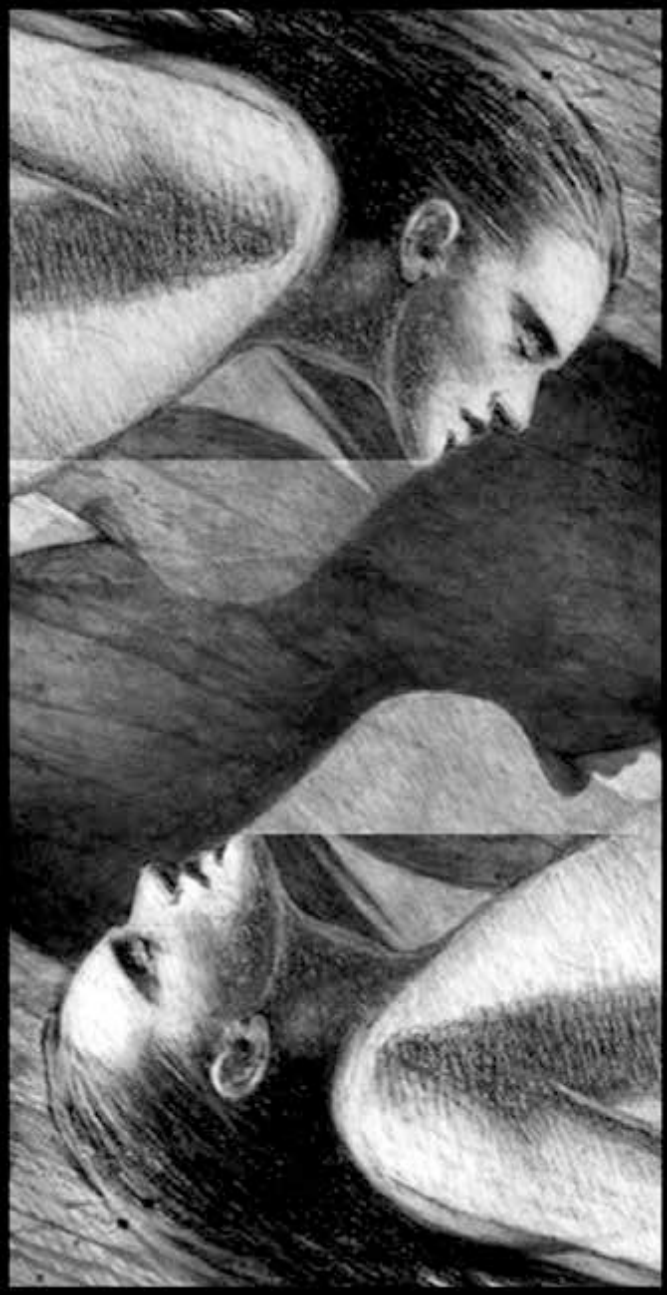
Figure 4 freezes a slice of the wandering and recursive creative dynamic. The shadow-self, released by dissolution of the ego, is represented as an agent of change in the phase space separating (joining) self and other, light and darkness, conscious restraint and unconscious drifting. It bears emphasizing that unconscious drift or digression is not passive, but actively facilitates discovery of remote, diverse and novel associations. In other words what drives creative incubation is not merely the absence of conscious thinking, but the mobilization of unconscious processes that are more adept at combining and integrating information. By way of these extrarational undercurrents, teeming with elements that circulate, beguile, and connect unpredictably, a novel idea emerging spontaneously into consciousness is often experienced as if it had appeared "out of the blue."
CREATIVE INCUBATION AS DETERMINISTIC CHAOS
Because the laws of growth are purely deterministic, a single snowflake maintains near-perfect symmetry. But the nature of turbulent air is such that any pair of snowflakes will experience very different paths... and the combinations may as well be infinite
The form of a primordial image [interchangeable with "archetype"] might be compared to the axial system of a crystal, which, as it were, preforms the crystalline structure although it has no material existence of its own... The concrete form of the individual crystal may vary endlessly.
Insights arising suddenly from seemingly irreconcilable contradictions or intractable dilemmas often signal complexity, making creativity highly amenable to exploration by way of nonlinear dynamics. Supremely sensitive to the smallest initial inputs as well as ongoing feedback loops, creative behavior is spurred by the tumultuous interplay of fluctuation and irreversibility, chance and constraint. But how does the synthesis of unconscious data-fragments actually take place? Is there a mechanics of creative incubation that explains "aha" experiences? Freeman frames and answers the question this way: "How do we come to dream of that which should be but is not, and then act to realize the dream? In principle the material mechanisms by which novel patterns are created through nonlinear dynamics can explain the process... though speculations are not thereby excluded that spiritual events may parallel material processes"
These nonmaterial "mechanisms" were Jung's focus, not as spiritual events but in the psychodynamics of transcendent function as embodied by archetypes like the sea journey: a power or influence "that exercises a numinous or fascinating effect, or impels to action"; the "mnemic deposits" of ever-recurring psychic experiences, analogous to physiological dispositions; "an inherited organization of psychic energy which not only gives expression to the energic process but facilitates its operation, being the counterpart of instinct". Leaving aside debates about the heritability of such a "collective unconscious," controversial since Jung introduced the concept nearly one hundred years ago, archetypes are best defined as unconscious action-tendencies, resonant primordial matrices that may advance creative incubation in much the same way as deterministic features of any complex system affect change: as robust yet purely formal possibilities of ideas, never representations of specific ideas.
Recently the notion of inherent psychic dispositions, akin to instincts and primary emotion circuits, has gained traction, bringing aspects of neuroscience and myth closer together. Damasio for example postulates that the "genomic unconscious" began with the basic design of our brain circuitries and accounts for earliest human adaptive behaviors, from survival instincts to improving post-survival quality of life by the shaping of the arts. An affectively embodied view of mind thus ranks the faculty of imagination among the repertoire of our considerable unconscious know-how. Panksepp also speaks of "instinctual memories ingrained in our genetically promoted neural organizations, which are retrieved and refined as we interact with challenging aspects of the world". Once activated and sensitized, these intrinsic neurodynamic systems including the core emotional SEEKING urge, lead to affective states that are shaped further by life experiences.
As it does in complexity, chance features prominently among those influential experiences. If the unconscious is the seat of uncreated primal mystery, undifferentiated yet capable of endless differentiation, then chance may be its operative voice. From this emphatically energic vantage point of life's chaotic processes, including the sensed dynamism of ancestral psychic events, the creative-ideation system may "sense" an effective idea and respond by amplifying it, leading elements to coalesce but differentiate in much the same way as any chaotic system reaching critical instability. In the incubatory phase, such instability would incite endogenous resources to self-organize, while aleatoric forces prompt unforeseen leaps; at the crucial moment of transition, as Nicolis and Prigogine point out, "only chance will decide".
Chance invites us to act as if we could access the unmediated generative power of prima materia, summoned by the mysterious alchemy of solve and coagula. In doing so, it animates the sea journey that is creativity.
Pattern
A chaotic system has the capacity to create novel and unexpected patterns of activity. It can jump in a virtual instant from one mode of behavior to another, because it has a collection of attractors each with its basin, and it can move from one to another in an itinerant trajectory. It retains in its pathway across basins its history, which fades into its past, just as its predictability into its future decreases
The interrelationship of nature, art and pattern is profound. In the neural system, cascading interactive series' of destabilization and convergence lead to new forms of patterned activity that are never twice the same, and "may underlie the brain's ability to generate insight and the "trials" of trial and-error problem solving". Likewise in creative systems, chaos is the rule. During the incubation phase of a painting, for example, unconscious input continually destabilizes pre-existing ideas and routine thought-patterns, the immediate effects of which (e.g. unusual linkages) are incorporated and contribute to further nonlinear cycles of change. Following each state change the composition qua system converges to a unique new iteration, which may then enter a phase of evaluation and refinement by intentional application of certain guidelines or methods.
Perhaps the single most important compositional tool in visual art is an overall pattern formed by the treatment of light and dark values. Depending on their relative distribution (chiaroscuro in the Western tradition, notan in the East), a design gives rise to either a sense of balance (symmetry) or imbalance (asymmetry, irregularity, tension). Whereas evenly balanced arrangements can appear static, the disequilibrium of irregular, asymmetrical balance moves the eye through an image, imbuing it with the appealing vitality of perceived incompleteness. This paradox of finding beauty in imperfection and the feeling of transience is central to the Japanese aesthetic of wabi sabi, most often achieved or intensified by chance, e.g. in spattered ink, found objects, weathered wood and fractured pottery repaired with gold in deference to the flaws that are believed to enhance its beauty. Ideally, an artist/maker has neither attachment to perfection nor imperfection, only appreciation for the natural "thusness" residing in all things. Constraints are involved, but control is beside the point. From this state of open-mindedness, beyond judgments of good or bad, work proceeds dynamically and organically.
In addition to the subliminal tension between light and dark, many other conflicting opposites provide a latent source of visceral and visual power, such as: positive-negative space; line-form; illusionistic depth vs. flatness; overlapping vs. isolated forms; saturation vs. transparency; and advancing or hot vs. receding or cool colors. Like strange attractors, these qualities have basins of influence with unstable boundaries; some will be irreversibly crossed as the nascent work is energetically shaped by the push of uncertainty and the pull of aesthetic appeal. The entire creative process exhibits striking dependence on, and high levels of sensitivity to, fluctuating reciprocal states between the artist and her evolving object or idea, and the autocatalytic progression of the idea or object itself
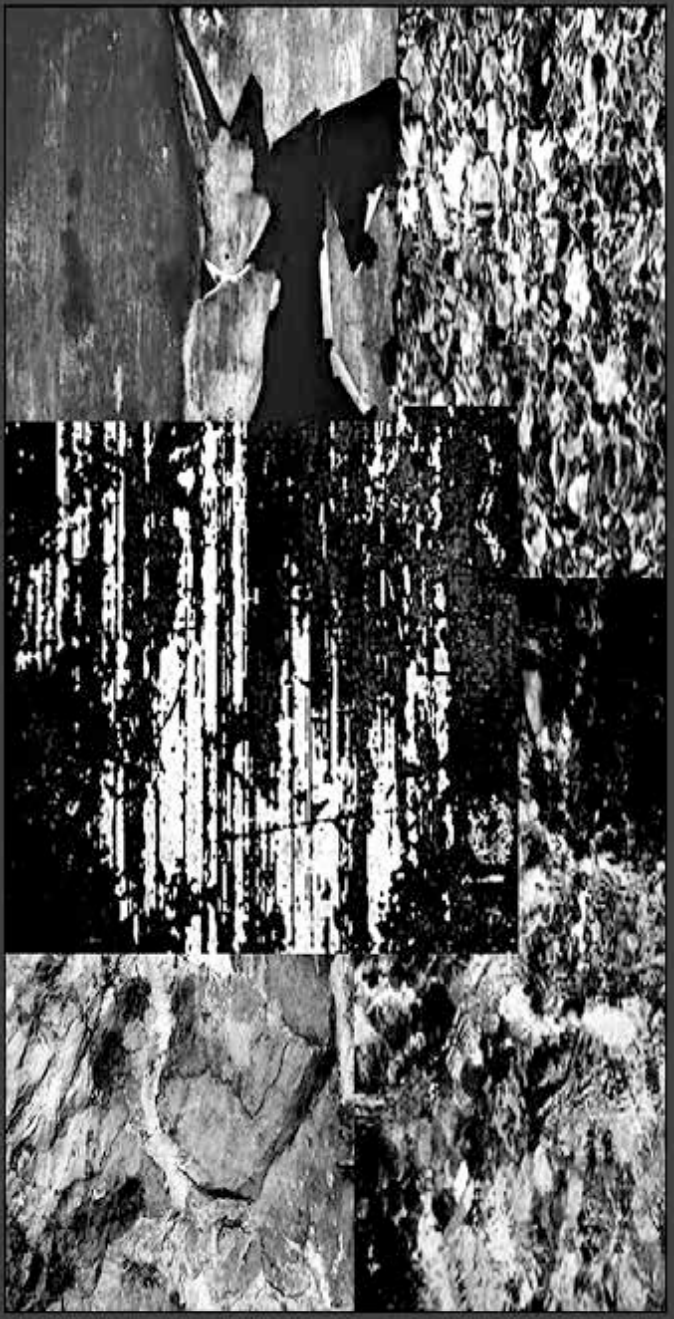
Studies confirm that uncertainty and ambiguity not only mobilize creative energy, but that embracing contradictions inherent in paradoxical frames (similar to Janusian process) increases creative behavior. No less a paragon of creativity than DaVinci agreed, exhorting young artists to seek inspiration in the sublime ambiguity of nature's patterns: "Looking attentively at old walls, stones and veined marble of various colors, you may fancy you see in them landscapes, battles, figures in motion, strange countenances and an infinity of other objects. By these confused lines the inventive genius is excited to new exertions". Figure 5 is a composite of photographs I have taken of almost glyphic patterns in peeling walls and jumbled river stones. Rich fare for imaginings.
As recounted by Orsucci the emerging awareness of a possible solution to a problem "has been vividly described as the detection of a new pattern in which whole and complex situations are suddenly seen in a new light. It is as if a higher order observational mechanism has accessed properties of new structures, as generated through the interactions of previous experiences". It could be speculated that affect, reaching below conscious awareness and beyond temporal immediacy, may serve a similar kind of internal "observational" function, one that facilitates the covert gathering and unconscious assembly of parts into new aesthetically eloquent patterns. Belying its intricate history, traces of the creative journey collapse into a single, final idea or artifact as in phase-state portraits of a physical system. In best-case artistic scenarios, however, evidence of the tension between elements that spurred the process continues to animate a completed work. Corot, for example, weaves a surprising note of complementary red into predominantly cool landscapes, giving them a more textured and pungent voice; and daVinci's exquisite linear precision intermittently melts into atmospheric sfumato, infusing his subject with mystery
Beauty
Chaos theory reminds us that for any creative act, there is first of all an object of desire. Quoting Feigenbaum, Gleick writes: "Somehow the wondrous promise of the earth is that there are things beautiful in it, things wondrous and alluring, and by virtue of your trade, you want to understand them". In the very term strange attractor, the anthropomorphic connotations of fascination and even seduction are as valid as its meaning in complexity theory. Beauty is a "deep aesthetic" that is its own kind of logic; it may be the constraint most responsible for propelling creative systems far-from-equilibrium, into the vast multiverse where original ideas germinate. Well beyond basic requirements for survival and homeostasis, humans are driven to respond to stimuli in innovative ways that differentiate, elaborate and unpredictably transform life. Whatever one's "trade," the wonder and allure of a puzzle, the promise of pleasure in its novel and fitting solution, undoubtedly galvanize creative behavior
Neuroscience appears to support the notion of an emotional-aesthetic dynamic underlying creativity across disciplines. Recent findings show that experiencing beautiful art or music arouses the same part of the brain that is activated by the experience of mathematical beauty. This suggests not only an inherent, abstract quality of beauty that exists independent of culture and learning, but also, what is most compelling, that the principle of mathematical simplicity as indicative of fundamental truth in accord with the laws of nature, might more appropriately be seen as subordinate to the principle of beauty. And neuroimaging technology reveals that emotional input from the primitive limbic system (Latin limbus, "edge") can bias an attractor landscape, so as to facilitate capture by a basin of an attractor that corresponds to a particular goal. What we unconsciously hope for or desire must therefore be counted among the evershifting balance of interactions that shape what we think and how we act.
Concurrent with a vision of the mind-body organism as an indissociable whole, embodied emotion is regaining some of the prominence it long held in ancient cosmogonies and philosophies. Somatic markers, for example, colloquially referred to as "gut feelings," may have evolved as an automated system to warn against danger and to provide a "beacon of incentive" when a positive outcome was detected. Operating in connection with an unconscious "as-if" loop, these markers may be responsible for constructing unconscious "preview" patterns that rapidly simulate actual feeling states, serving to qualify potential options as either favorable or unfavorable and supplying appropriate predictive feedback. Similar bedrock affective dynamics is a likely candidate factor in creative incubation.
With Poincaré, Hadamard saw the sense of beauty as an indispensable means of finding: "to the unconscious belongs not only the complicated task of constructing the bulk of various combinations of ideas, but also the most delicate and essential one of selecting those which satisfy our sense of beauty and, consequently, are likely to be useful". Central to every act of invention, affect arouses the inherent creative drive (what to do), sparks a process-mechanism (how to do it), and may ultimately lead to functionality via beauty, as truth or suitability, of form. For now, however, beauty as a "means of finding" can be experienced but not parsed.
ENTRY POINTS
Neutralization and inactivity of consciousness bring about an activity of the unconscious, where all the differentiated functions have their common, archaic root and where all contents exist in a state of promiscuity. From the activity of the unconscious there emerges a new content, constellated by thesis and antithesis... that forces the energy of the opposites into a common channel... and life can flow on with renewed power toward new goals.
Mythically, psychologically and dynamically, creative incubation is an erratic, fitful journey through intertwined past, present and future, an unpredictable voyage from darkness into light and disorder to new order. Where causeand-effect analysis inevitably disappoints, complexity offers correlates for the obscure underpinnings of creativity.
Still, the steps from unconscious primal material to innovative idea remain elusive. "Identifying unconscious association as a creative principle is one thing," Boden writes, "to say how it works is another… What are the hooks and eyes of memory, how do they find each other, how can they fit together to produce a novel form?". And, Baird et al. admit, "further research is needed to determine why (italics original) the unrelated thoughts that occur during mind wandering uniquely facilitate incubation". Future research, Sprott suggests, might explore whether individuals exhibit an increased Lyapunov exponent in their EEG recordings while performing creative tasks, a measure not yet applied in this context. More clues perhaps, though not necessarily explanations of how unconscious choices are made among countless options. Any underlying mechanisms that might exist are blurred by uncertainty, a condition virtually synonymous with the pursuit of creative goals.
Faced with this seemingly infinite regress, Prigogine's famous statement that non-equilibrium brings order out of chaos becomes a sort of radical anti-template for creativity. Only by paradoxical means are incubatory fires stoked: by retreating in order to come nearer, knowing otherwise than rationally, and following inscrutable leads to reorganization hewn from disintegration. While every creative "descent" unfolds differently, a significant constant is venturing out-of-bounds, -balance, -focus, -control, out-of-one'selement and (rational) -mind; and, finally, returning as both the same and different. The advantage that artists and other creative individuals enjoy, according to Jung consists precisely in this "permeability of the partition" between conscious and unconscious. Nonlinear dynamics, simultaneously separating and uniting the known and yet-to-be-known, effectively limns the conditions for access to this volatile seedbed of invention.
As recursive but ever-differing trajectories of search and selection disappear into themselves, order is continually destroyed and created until a single iteration crystalizes into something new that is identified as "creative:"
Vague, distributed, and unconscious mental representations evolve into crisp conscious perceptions and cognitions. Only the final state of this process is conscious; the vague origins and the process itself are unconscious. This vague-to-crisp, unconscious-to-conscious process is a foundation for creativity... Thinking creatively is risky and conclusions are uncertain, but only this way does knowledge accumulate and culture evolve.
"Vague," from Latin vagus meaning literally "wandering, rambling," brings us back to the archetypal night journey and its neural counterpart, mind wandering- - a process that occurs naturally in the time- and scale-free realms of sleep and daydreams. Awake, on the other hand, we must resort to simulating these labile states of unknowing through strategies like brainstorming, Janusian process, challenging assumptions, and engaging chance. These and other related approaches induce a form of conceptual disequilibrium that stirs the imagination, but they only go so far.
This much is certain: whether awake or dreaming, the grip of what is familiar and fixedly habitual must be broken, even briefly, if imagination is to be liberated. Over the ensuing inner journey, affective energy plumbs the fathomless well of the unconscious, playing and choosing what it "likes" from seething protean elements that offer untold possibilities. Problem-solving largely honors these submerged dynamics of hedonic attraction: the frisson of excitement that accompanies impressions of good fit, of solutions that "feel" right, is an embodied herald of emergent creativity
Beginning with the prima materia of original creation, a desire for harmony of form and function navigates the profusion of micro-orders swirling amid disorder; affect is the jolt of positive energy in the space between actual and potential. While the conscious mind is geared to discriminate, to serve awareness by separating the opposites, it does so contra naturum. In nature, Jung writes, the opposites seek one another: "les extrèmes se touchent, and so it is in the unconscious". He cites Heraclitus' law of enantiodromia as an ancient example of this contrariwise dynamic, leading eventually to everything running into or becoming its opposite, "especially as a governing principle of natural cycles and psychological development". One finds this in creative products as well as process, e.g. the science of art in fractal forms of Pollock's drip paintings; and the art of science, so apparent in fractal images and cellular neuroimaging
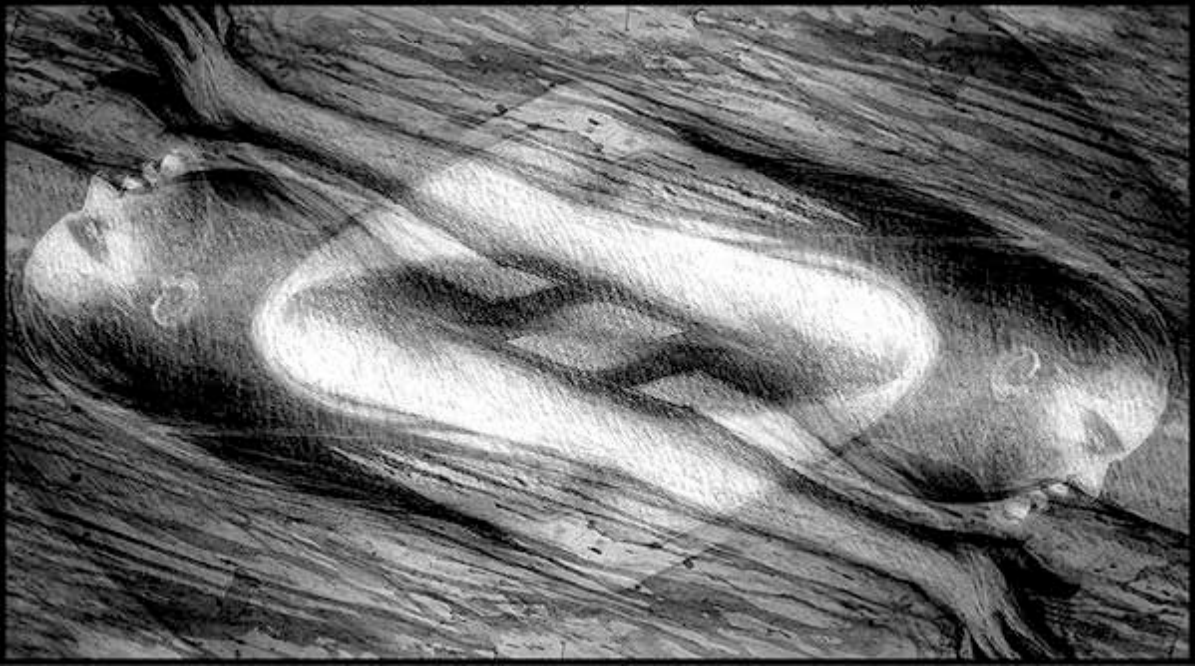
Figure 6 illustrates the edge-of-chaos power in all creativity, dissolving boundaries between what is and what could be. Uroborus-like, extremes touch, combine, destabilize, change, touch, combine, repeat. This is a charged phase space in which common associations are de-familiarized, made strange, and the ordinary is re-seen as both irrationally confounding and more profoundly cogent.
Where uncertainty is leveraged, then, bringing errant (nonlinear) and contradictory forces into play, creativity is buoyed. Where serendipity and intentionality intersect, chance enters the process -- tapping universal currents, invigorating cognitive-emotive connections, and expanding imaginative possibilities. It is the potency of this unknowing state that unites creative incubation and chaos
UNKNOWING-KNOWING: IMPLICATIONS
The creative urge, which finds its clearest expression in art, is irrational... The creative act, being rooted in the immensity of the unconscious, will forever elude our attempts at understanding. It describes itself only in its manifestations.
VA superior, indeed the supreme, mode of knowledge, ... is the absence of knowledge, an unknowing that destabilizes the distinction between sense and nonsense.
There is an increasing need to bring dispositions of unknowing closer to center in the broad discourse on creativity. Long sidelined as insignificant, if not retrograde, these ancient sensory-perceptual and affective states of being are now recognized as essential to the progress of self and the larger world. Neuroscience indicates that primitive unknowing forms of consciousness (anoetic, i.e. pre-reflective and deeply unconscious) provide the scaffolding for higher (noetic, autonoetic) forms of knowing, and affect is now understood to be in mutual partnership with cognition. The undertow of emotion may not be more relevant than the "experience of experiencing" that we call consciousness, but neither is it less. Chaos sees constructive power in the ever-present interplay of these and myriad other opposites, thereby establishing a literal and figurative meta-view of the human condition that augurs well for creativity.
This article has offered an interdisciplinary exploration of creativity via the motif of productive errancy. First considered was Jung's transcendent function as envisioned in the night sea journey: an oppositional dynamic of disintegration and self-reorganization, enabling both psychological and creative growth. Mind wandering, crucial to the neurodynamics of insight, was then briefly reviewed. These intervals of task-unrelated thought trigger disengagement and divergence from conventional ways of seeing, and may be seen as analogous with the unconscious itinerancy of creative "sea journeys." Finally, it has been argued that the richest trove of clues to accessing creativity is found in the nonlinear dynamical systems perspective. Widening major vistas on the process, it strongly affirms uncertainty as a condition favorable to invention and a quality to be cultivated, rather than avoided or merely tolerated. It stresses the vital role of "promiscuous" factors in combinatorial activity and aesthetic selection, including unconscious dispositions, primary emotions, and unpredictable chance attractions. It validates the unknown and as-yet inexplicable as critical features of productivity in any complex system. The same openendedness and ambiguity that prove so vexing for rational methods make nonlinear models and metaphors perfectly suited for enhancing problem solving in any domain.
From the microcosmic turbulence of unconscious content to the whirling macrocosm of our universe, chaos theory gives us fresh indications that the darkness of things irrational or bizarre is, paradoxically, the illuminating source and motivating force of that most fundamental of all natural phenomena: creativity.